What we choose to put in our bodies can have serious negative consequences or be the driving factor behind healing and feeling our absolute best. Your body is a machine, and food is the fuel. Our cellular makeup, hormones and brain chemicals are all made up of the nutrients we eat.

When we miss out on certain nutrients from our diet, we may see an altered or lowered production of the chemicals that utilize them. This is why it is important to begin eating mindfully. Typically, most people eat with mostly ambivalence when it comes to dietary needs and their choices are mostly based on convenience and desire.
When we switch to eating mindfully, we factor a lot more into our food choices. This section will outline what to keep in mind in order to start making mindful food choices that support your body. First, let’s start with some basics about energy and nutrient needs..
Everyone has calorie (energy) needs and nutrient (macros, vitamins and minerals) needs. The right diet for you is one that supplies the right calorie needs based on your fitness and body weight goals and the right nutrient needs to keep you in great health.

Calorie needs can be simplified into the following three categories based on each person’s goals…
- Maintenance Calories: the amount of calories you need to eat everyday to maintain the weight you are right now
- Calorie Deficit: eating less than your maintenance calories which will result in weight loss
- Calorie Surplus: eating more than your maintenance calories which will result in weight gain
These numbers are determined mostly by your current age, height, weight and activity level. They can also be influenced by factors like any current illnesses, pregnancy, diagnosed hormonal or thyroid disorders or other metabolic factors.
But it’s not just about how much you eat, but also WHAT you’re eating.
The basic kinds of nutrients to be aware of are…
- Macronutrients: these are our main types of calories – carbohydrates, lipids (fats) and protein.
- Carbohydrates (think bread, pasta, vegetables etc.) are the most readily available source of glucose for our body and supply us with energy, but too many and the wrong kinds can lead to weight gain and inflammation.
- Lipids/fats (olive oil, avocado etc.) are essential for producing and regulating hormones, help to lower inflammation and reduce hunger.
- Protein (chicken, beef etc.) are the building blocks of our muscles, help us maintain a healthy metabolism, help us achieve and maintain a healthy body weight, and also reduce hunger.
- Micronutrients: Micronutrients are the smaller nutrients found in the different kinds of food we eat. These are vitamins and minerals/electrolytes. Their jobs are to support our cellular and neurological functions, as well as serve as the building blocks for our organs, skin, bone marrow and hormones. The main ones to be aware of are listed in the diagram below. Micronutrient intake is one of the main reasons it’s important to include plenty of fresh protein, fruit and vegetables in your diet – aka lots of color and natural variety! While these foods also help our gut, hunger hormones and mood, a steady supply of these nutrients is especially important to help our bodies fight inflammation and disease.
Eating for Optimal Health – “The Creator Diet”
“And God said, Behold, I have given you every herb bearing seed, which is upon the face of all the earth, and every tree, in the which is the fruit of a tree yielding seed; to you it shall be for meat.”
Genesis 1:29

While it can seem daunting to try and track all of these nutrients in your diet, with the right approach, it’s rather simple to set yourself up to get everything you need.
You will need to follow what I like to call “The Creator Diet” which means eating whole, unprocessed foods closest to the way God designed them. For instance, an apple is a whole, unprocessed food – there is no list of ingredients in an apple, it just simply is already in its most natural form. Black beans, cucumbers, sweet potatoes, eggs, brown rice, grapes, chicken.. These are other examples of what are considered whole, unprocessed foods. Each of these don’t need their own ingredient list and it’s easy to understand what they are, and what we are putting in our body when we eat them.
On the contrary, if we were to take a look at the list of ingredients on the box of a frozen pizza, cookies, or fruit roll ups.. There would likely be a whole list of added sugars, inflammatory oils, preservatives and dyes. Generally, the more ingredients, especially those that we can’t immediately recognize, the further that product is from its original source. These are generally referred to as processed foods.

There are a few main problems with processed foods. First, they tend to be more calorically dense – meaning they pack more calories in less volume of food. Your stomach generally registers fullness by the volume of food you’ve consumed. Therefore, if you’re consuming more calorically dense, processed foods, you’ll consume more calories before feeling full, compared to if you were eating whole, unprocessed, less calorically dense foods.
Processed foods also tend to be more inflammatory and lower in nutrients, meaning they can raise cortisol levels in your body (which can make it easier to gain weight and harder to lose) and take up calories without supplying the micronutrients your body needs. They also tend to be much lower in fiber content, which is needed to help regulate your hunger hormones and digestion. This is why it’s important to read ingredient labels when you are buying food and food products. Sticking with simple, easy to read ingredients for your meals will make it easiest to keep calories lower, nutrients higher and fiber higher.
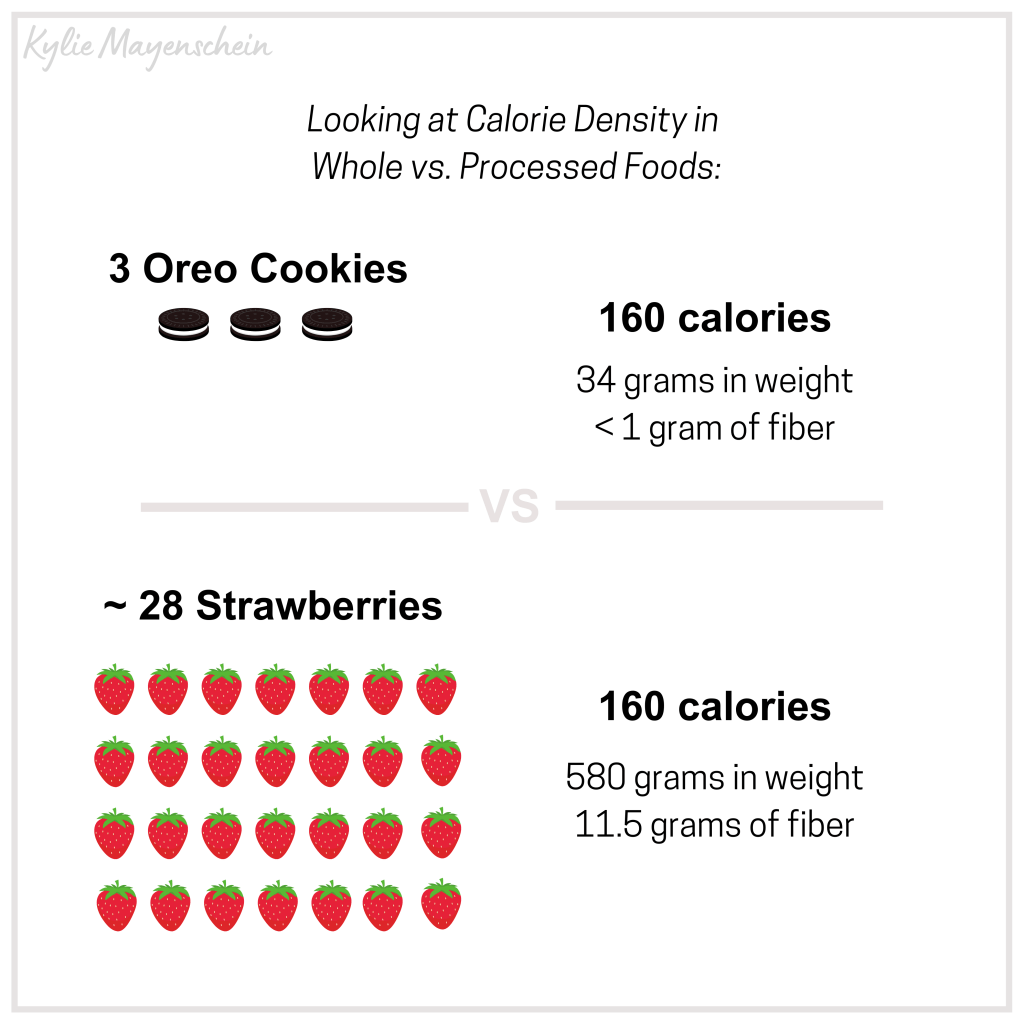
Let’s look at an example of a whole food versus a processed food: strawberries versus Oreo cookies. One serving of Oreos is generally three cookies for approximately 160 calories. Meanwhile, you would need to consume about three and a half cups of strawberries, around twenty-four large strawberries, to reach those same 160 calories. That would be about 580g of strawberries, and only about 34g of Oreos.
580g of strawberries would not only be much more filling, and allow you to stay full longer, it would also supply a much higher amount of fiber (about 11.5g in the strawberries versus less than 1g in the Oreos). There would also be a much higher dose of micronutrients in the strawberries, such as magnesium, phosphorus, calcium, folate, and Vitamin K.
While there is still sugar found in both of the foods, thanks to the polyphenols found in the strawberries, like other fruits and vegetables, your body would not process the natural sugars in the strawberries in the same way as it would process the refined cane sugar in the Oreos. The strawberries polyphenols and higher fiber content will help the strawberries generate a lower insulin response from the body. The higher the insulin response to the foods we eat, generally, the more likely your body is to store the calories as fat.
Sugar, The Gut Microbiome & Cravings
The other main problem that arises with processed, sugary foods is that the more you eat them, the more you come to crave them. This is mainly due to the nature of the microbial gut complex and the pleasure receptors in the brain. The gut is made up of billions of microbes that feed on the foods we eat. They can come to expect certain foods the more you eat them, and then trigger the desire for that food when you’ve gone without it for a little while. Thus, the more you eat sugary foods, the more your gut generates bacteria for them, which then can generate cravings for them, even if they are not beneficial to your health.
The gut is also directly connected to the brain, where these foods also tend to activate our pleasure centers and create feelings of comfort and excitement. This is not unlike when someone consumes drugs or alcohol, and becomes reliant on this reaction in their brain overtime. Sugar can trigger the same release of dopamine and become addictive over time. This is why it can be especially difficult to change your eating habits at first.
However, your gut biome changes over time, as do the receptors and neural pathways in your brain. This means as you continue to make healthier choices, and fill your diet with high quality proteins, vegetables, fruit and other unprocessed options, your body will come to enjoy these foods more, desire them more often, and it will be easier to resist sugar and other indulgent options.
Now, even though we have gone through several reasons why we want to consume a diet of mostly whole, unprocessed foods, that doesn’t mean we can’t cook, season, marinate, combine or add sauces and extras to food. It also doesn’t mean we can’t ever have our favorite packaged snacks or more indulgent options (or that everything that comes in a wrapper is automatically bad for you.) it’s just simply a guideline to help you exercise the best judgment in making food choices a majority of the time.
With that said, it’s also important to remember that enjoying food is not a negative thing, or a moral failure. We just have to practice moderation, an idea that is also mentioned in The Bible.
A Time for Indulging…
“Then he said unto them, Go your way, eat the fat, and drink the sweet, and send portions unto them for whom nothing is prepared: for this day is holy unto our Lord: neither be ye sorry; for the joy of the Lord is your strength.”
Nehemiah 8:10
Notice how this verse from Nehemiah mentions enjoying and indulging in food this day. Whether it be holidays, birthdays, special occasions, or maybe just a bit of celebrating at the end of a long week, there is a time for indulging in and enjoying food. Not all of life needs to be salads and vegetables. We just want to ensure that “this day” does not become every day. Finding this balance of moderation will look different for different people, depending on their lifestyle and goals (more on this in the next section), and may change over time. It does also require a sincere level of honesty with ourselves. We have to be able to acknowledge when we are over indulging and course correct. Yet, that doesn’t mean we have to, or should, stop enjoying food entirely. We also don’t want to find ourselves swinging from one extreme to the other. Extreme deprivation of foods we enjoy can lead us to binge and over consume them in the long run. As you practice moderation and making healthier choices, it will become easier to decipher what the right balance is for you.
 Modest Fitness